KimStanleyRobinson.info

The reference site for Kim Stanley Robinson

Category: The Years of Rice and Salt

  • Nsara

    Nsara is Book 9 of the novel The Years Of Rice And Salt.

    Summary

    Budur is a young woman in her father’s harem in Turi. She escapes to Nsara to her aunt Idelba. Idelba is a scientist that is discovering radioactivity and nuclear reactions. Idelba attempts to assemble an international scientific community that will be able to handle these new discoveries and not bring the world to a catastrophic war. Budur meets Kirana, a history teacher and also an activist for women’s rights in Islam. Budur experiences the rich social life of Nsara, a city at the center of social, cultural and scientific discoveries. Social protests weaken the Islamic rule and a coup threatens to break into an insurrection spanning continents. Thankfully, a Hodenosaunee fleet comes to establish international law and defuse the tensions.

    World history

    c.1999-2002

    Characters

    • B : Budur Radwan, young woman, archaeology student
    • K : Kirana Fawwaz, Algerine woman activist, history teacher
    • I : Idelba, nuclear scientist, Budur’s aunt
    • S : Madame Sururi, Zott seer

    Thesaurus & Encyclopaedia

    Based on the Trivia and Study Guide compiled by Mark Rosa in 2004. Page numbers from the US paperback edition.

    586 Turi : Torino; often called Turin in English, a city in northern Italy. Perhaps Zurich, a city in Switzerland, which is called “Züri” in Swiss German.

    588 heartknot, yang, yin : The nucleus of an atom. Protons and electrons really are called yang and yin particles in Chinese and Japanese.

    588 “strong, but very local” : This is the strong nuclear force, which is overwhelmed by the force of gravity and electromagnetic forces at human scales.

    588 alactin : Uranium, the 92nd element. Bombarding U-235 with neutrons causes it to become U-236 (the additional unit of atomic mass is the neutron), which releases energy plus more neutrons, which can interact with other U-235 atoms. This chain reaction is explosive!

    592 djellaba : This should more accurately be “djebella”; it’s spelled correctly several times later on.

    593 the speed of light, half a million li per second : In metric, the speed of light is 300,000 km/sec. A li would be about 600 meters. The book misquotes the equation for energy-mass equivalence here. “[M]ultiply [the mass] by the speed of light and square the result”, which would give E = (mc)2 not E = mc2.

    598 zawwiyya (“boardinghouse for women”, “antiharem”) : (or zawiyya) Islamic shrine, though the cults performed there can pre-date Islam. The great majority of occupants are women and zawiyya cults have often been presented as a female parallel to the masculine Sufism.

    605 frequently falsified authorities of personal transmission : Note that Bistami fudged these things for just the opposite reason almost 500 years earlier.

    606 “as a kasbah or a medina” : A kasbah is an Islamic city in Northen African countries. The medina is the fortified historic center of the city, as opposed to the more modern, westernized quarters.

    607 Haroun al-Rashid : Abbasid Caliph of the 8th century AD.

    607 a white tomb in the jungle : Here Budur sees her past lives as Butterfly and Bistami.

    612 standing stones : Could be the Carnac megaliths in Brittany, northern France; 10,000 stones which are more than 4000 years old. Like Stonehenge, we’re not sure what their purpose is, though it’s likely that they were used to measure star positions. A legend says that Roman soldiers were turned to stone to form these megaliths.

    613 the Orkneys : Islands at the northern end of Great Britain.

    614 caves in the south, filled with wall paintings : These would be the Lascaux caves, where paintings thirty to forty thousand years old have been discovered.

    623 circular mandala : It’s hard to imagine the periodic table of the elements arranged in a circle. Perhaps it’s a spiral with each group arranged on the same spoke.

    626 lifegas : Oxygen.

    631 Aozhou : 澳洲 Australia. Usually written 澳大利亞 today, a more phonetic representation. This may be an anachronism, since the Chinese “ao” character is based on the first syllable “au” in Latin, which may not be given to the continent in this world.

    631 Kwinana : A town in Western Australia in our world, with a population of around 20,000.

    634 Dinei : Usually spelled “Dene”; Native Canadians from the Great Slave Lake area and the Northwest Territories.

    640 “Hell is other people” : In our world, this line comes from Jean-Paul Sartre.

    644 five-trillion-drachma bills from Roma : An example of inflation. For example, after Germany lost WWI in our world, heavy reparations payments forced the government to devalue the currency in 1923, and the resulting hyperinflation had people spending banknotes worth billions of marks and carrying wheelbarrows full of bills just to buy household items.

    645 “Come fill the cup…” : From the Rubaiyat of Omar Khayyam (AD 1048-1123; Nishapur, Persia), quatrain 7; English translation by Edward FitzGerald.

    649 “Kirana’s mouth opened round as a zero…” : This would be somewhat of a challenge given that an Arabic zero is a dot. It might be more accurate to say that her mouth opened round as a five, since in Arabic, five is an oval.

    659 Hosain’s martyrdom : The grandson of Mohammed, who was murdered. See Bistami’s tale for more details.

    667 Moroccan lost fleet of 924 : ?

    675 lifering fourteens : Atoms of carbon-14, a radioactive isotope which decays regularly, allowing an observer to measure the age of an object by finding the ratio of C-14 to the normal C-12. The inclusion of “ring” in the name presumably refers to its atomic structure.

    677 Ganono : New York in our world. Ganono is the Mohawk name for the Manhattan area, and means “reeds”. It was eventually supplanted by the Delaware word “Manhattos”, which means “hills”.

    679 Cyrus : (580-529 BC) Became king of Anshan in 559 BC (thus the comment by the Cyruses that this year is his 2561st), and later conquered many parts of Persia. He was a benevolent conqueror who didn’t force religion on people, and is said to have written the first declaration of human rights. Incidentally, the year is given in the North American version (corrected in the British paperback) as AH 1381, but though 1381 solar years have passed since Mohammed’s Hegira, that calendar uses lunar years, and the spring of AD 2002 should be AH 1423 (as given in the Chronology in the beginning of the book). A system of counting solar years since the Hegira has been used in Iran, but KSR seems to have all his characters, Iranian or not, using it.

    679 Ferdowsi : …is the correct spelling (not ‘Ferdowsi’) of this Persian literary giant. (935-1020) His Shahnamah, or Book of Kings, is one of Iran’s greatest literary works (if not the greatest) and has had a lasting impact on the Persian language It can be found online here.

    683 the years around 777 : If KSR’s Iranian reckoning from page 679 is continued here, this would be around AD 1399.

    686 “Caves in the Nsaran south” : These are the Lascaux caves mentioned earlier.

    688 “An Inka capital, set high in the mountains… skeletons of people in Firanja… stone rings of Britain” : Macchu Picchu, the Neanderthals, and Stonehenge, respectively. The lined figures on the Inkan plains mentioned later are the famous Nazca lines.

    688 Ta Shu : A Chinese poet who visits Antarctica in KSR’s novel of the same name. I don’t know what characters you might write this name with.

    695 Kenpo, Iwang, Sidpa, Zasep, Dagyab, Tenga, Baram, Puntsok : Reference to the Tibetan village jati, see also Book I, note p.85.

    Quotes

    • (p.594: Budur’s experience of the mystic)
    • (p.688: a series of arachaeological findings, with theories and facts now outdated or cryptoscience)
  • The First Years

    The First Years is Book 10 of the novel The Years Of Rice And Salt.

    Summary

    Bao Xinhua joins the popular revolution of China, led by Kung Jianguo, who follows the teachings of Chinese-Japanese philosopher Zhu Isao. As the Chinese people is freed from the oppressive miltary government, the world passes through waves of modernization.

    Bao moves to a pacific Fangzhang (near where San Francisco is in our World) where he grows old and teaches and thinks about the sense of history.

    World history

    2030-2088

    Characters

    • B : Bao Xinhua, Chinese revolutionary, history teacher
    • K : Kung Jianguo, Chinese revolutionary leader
    • I : Zhu “Tuanjie-kexue” Isao, Chinese-Japanese revolution instigator, history scholar
    • S : Shi Fandi, Chinese revolutionary
    • P : Pan Xichun, Yingzhou diplomat
    • K (second time): Kali, one of Bao’s students

    Thesaurus & Encyclopaedia

    Based on the Trivia and Study Guide compiled by Mark Rosa in 2004. Page numbers from the US paperback edition.

    709 Dahongmen : 大紅門 “Big Red Gate”. This is the resting place of the Yongle Emperor, who began building Beijing at the beginning of our story.

    709 sanwu : 三無. The “wu”, meaning “not”/”without”, is the same as the “mu” in Zen.

    710 the Year 29 : Based on the calendar initiated at the Isfahan Conference, this would be AD 2030.

    710 the emperor, aged six or seven : Probably a reference to Pu Yi 溥儀, the last emperor of the Qing dynasty in our world and indeed the end of the long line of emperors in China. Pu Yi was six when forced to abdicate in China’s 1911 Revolution.

    711 Zhu Tuanjie-kexue : 朱 統結科学, probably, and with the meaning that KSR gives. “Zhu” means “deep red/vermilion”. His Japanese name, Isao (勇、勲、功 among others) can mean “brave”, “merit”, “achievement”, etc. Note that this is the same Zhu as in the Yongle Emperor’s personal name.

    712 Xinhua, Jianguo, Huidi, Zhandou : The characters for “New China” and “Construct the Nation” are 新華 and 建国. Huidi, “Oppose Islam” is 回敵 (this is the same “hui” we’ve seen before to mean Islam, by the way). Zhandou, “Do Battle” might be 戦斗; the girls’ names below might be 香兵、慧軍、公香、愛国蘭. Xinhua, with the same meaning, incidentally, is a Chinese news agency.

    712 Repayment, retribution : Presumably Bao’s name is 褒 or 報, though 包 is a much more common surname with the same pronunciation, meaning “wrapping”. There are several surnames that could be romanized as Kung; some are 鞏、貢、弓 (archery bow), 宮 (palace), 公 (public), 恭. Another is 孔 (Kong in pinyin), which is the name of Confucius.

    717 Shi Fandi (“Oppose Imperialism”) : The “fan” is 反, meaning “oppose” or against”; the “di” is 帝, meaning “emperor” or “imperial,” alternately “imperialism.”

    725 Pan Xichun : 潘 is a common Chinese surname.

    726 League of All Peoples : Evidently, an international organization like the League of Nations (1919-1946) or the United Nations (formed in 1945) in our world.

    735 Cao Xueqin : 曹雪芹 (c.1715 – c.1763). Author of a famous 18th century Chinese novel, “Honglou Meng”, or “The Dream of the Red Chamber”. It concerns the wealthy Jia family and is considered one of the masterpieces of Chinese literature. An online version of the novel is here.

    735 Murasaki : Murasaki Shikibu 紫式部 (973 – c. 1025), Japanese author of “The Tale of Genji”. This work, which revolves around the amorous hero Genji, the Shining Prince, is perhaps Japan’s greatest work of literature; it and her own diary are still well-read today. Her given name is unknown; Murasaki is a nickname taken from one of her novel’s characters, and Shikibu is a title (‘Department of Ceremonies’) her father held. Arthur Waley’s translation of Genji can be read here.

    735 Purana Kassapa : A sixth-century Indian religious leader, contemporary of Buddha, who taught akriyavada, or “inaction”. He believed that nothing could affect the human soul, and that no guilt was felt after sins, nor was any satisfaction to be had from good deeds. This is in complete opposition to the idea of dharma.

    738 Padmasambhava : A Tibetan guru who was/is the “essence of Buddha Amitabha”. This guru has uncountable manifestations, as he appears to each person in all the worlds.

    738 Gyatso Rimpoche, Lives One Through Nineteen : This is the Dalai Lama. “Gyatso” means “ocean” in Tibetan; Tibetans sometimes call the Dalai Lama “gyawa rimpoche”, meaning “great protector”. In our world there have so far been only fourteen Dalai Lamas; the present incarnation being Tenzin Gyatso (1935- ). Note that Gyatso Rimpoche is also the name of the nineteenth Dalai Lama in KSR’s Blue Mars.

    738 Plutarch : (Πλουταρχος, c. AD 40-120) A Greek writer from the era of Rome’s conquest of Greece. He discussed the lives of 46 people from former ages, pairing a Greek biography with a Roman biography. Despite its length, his “Parallel Lives” enjoyed enormous popularity during the European Renaissance. “Parallel Lives” can be found online here.

    738 Liu Xiang : (c. 77-6 BC) A Han bibliographer who edited the Book of Xunzi. His Lie Nu Zhuan tells the stories of various admirable women, and cautions readers against using their beauty to cause chaos.

    738 the Wandering Jew : Legend has it that a man who mocked Jesus as he was on the cross was condemned to wander the earth until Christ’s second coming. I’ve never seen an autobiography of this person, however.

    742 “Where did all the Roman gold end up?” : Considering that the people of the Byzantine Empire thought of themselves as “Roman”, this could be implying that the stash of treasure that Selim III left behind when fleeing Constantinople hasn’t yet been found.

    742 Sami people : The Saami are a small ethnic minority living mainly in Norway and Russia. Their reindeer-herding in particular is well-known and popular with tourists.

    745 “the scene blurred before his eyes…” : Here Bao is seeing an image from his past life as Butterfly, daughter of Peng-ti, after the flood of Fangzhang.

    747 Kalidasa’s “Sakuntala” : This translation comes from W. S. Mervin and J. S. Masson’s Sanskrit Love Poetry, as mentioned on the copyright page.

    748 Old Dragonfish : This is the coelacanth, a 400-million year old fish, contemporary of the dinosaurs, that was thought to be extinct before one was found off South Africa in 1938. Another was later discovered off Africa’s eastern coast.

    749 Putatoi : The Patwin tribe, native to Davis, California (where KSR now lives). The Putah Creek runs through the area.

    752 Gao Qingnian : Gao 高 is a Chinese surname meaning “high”.

    763 Kali : The Hindu goddess of destruction. While the B and I characters have lived long, happy lives of fulfillment — a nirvana on earth, almost –, it seems that the K character has returned to continue the struggle.

    Quotes

    • (p.724: things don’t change that easily)
    • (p.734-737: Zhu’s analysis of history (dharma & nihilism, comedy & tragedy))
    • (p.759: “What’s hardest to catch is daily life.”…)
  • Timeline of The Years Of Rice And Salt

    This is a Timeline for the events in the novel The Years Of Rice And Salt.

    Based on the Timeline compiled by Mark Rosa in 2004 (Original timeline here, offline since 2009). Page numbers from the US paperback edition.

    Comments on the calendars

    There are at least three calendars being used in thes story. One is the Chinese imperial calendar which numbers years by giving the name of the emperor and the year of his reign. This system, which ended with the inception of the republic in 1911, had supposedly been in use for over 4500 years, dating back to the first emperor. While modern documents might give the year as 4702, etc., the Chinese in fact did not count all the years up this way. Rather, they used 60-year cycles in which the twelve animals of the zodiac rotated with the ten celestial elements. This calendar is lunar and leap months are added as necessary.

    Another is the lunar Hegira (or Hijra) calendar, which counts lunar years (354 or 355 days long) since Mohammed immigrated from Mecca to Medina in September of AD 622. The first day of the first month (Muharram) was then assigned, based on the first appearance of a crescent moon, to September 16, AD 622. Because no leap months are allowed, the months rotate through the seasons, and conversions between the Christian and Islamic calendars are not trivial. This is the one I’ll use when I say ‘AH’.

    In an effort to rectify this, a solar Muslim calendar was introduced in Iran around the 16th century AD. This system counts the solar years since the Hegira, and is very easy to calculate if you’re familiar with the Christian calendar. Just subtract 621 from the Gregorian year. Despite its relatively minor status, this seems to be the calendar that KSR uses the most, even with characters unfamiliar with Iran. For example, AH 784 in this calendar corresponds to AH 807 in the conventional lunar reckoning.

    While the Christian calendar is barely mentioned in the story, it might be worthwhile to note that with Pope Gregory presumably never living, the 11-day adjustment to the Julian calendar, carried out at various times in the Christian world (1752 in England and colonies) will presumably not occur for the few Christians of KSR’s world.

    Timeline

    Events and people existing in both KSR’s world and ours are in italic.

    Book Year (AD) Year Event
    I 1405 AH 807 Temur’s army chooses to attack the Franks in western Europe, rather than China. A scout party, including Bold and Psin, finds eastern Europe decimated by plague. They return to the Mongol camp, and as Temur prepares to kill Bold and Psin in punishment, his tent is struck by lightning, killing him.
    Summer 1405   Bold wanders south through Greece and is picked up by slave traders. He is sold to another trader and then to Zheng He’s fleet.
    1405-1407   Zheng He’s treasure fleet completes its voyage and returns to China.
    1406 Yongle 5 Zhu Di, the Yongle Emperor, begins constructing a new capital at Beijing.
    1424 Yongle 23 The Yongle Emperor dies and is succeeded by his son, the Hongxi.
    II 1571 AH 979 Akbar, Emperor of the Mughals, constructs his capital of Fatepur Sikri.
    Sep 1573 AH 981 Akbar’s forces defeat insurgents at Ahmadabad, bringing Gujarat back to his empire.
    After 1573   Bistami’s caravan passes through the Maghrib to Europe.
    1579 AH 987 Sultan Mawji Darya of Baraka is killed.
    III & V 1597 Wanli 25 (C); Keicho 2 (J) Japanese general Toyotomi Hideyoshi makes his second attempt to conquer China through Korea. A joint Chinese-Korean force repels him, bankrupting the Wanli’s treasury.
    1600   Tokugawa Ieyasu defeats rival shoguns at the Battle of Sekigahara and unites Japan under his rule.
    Feb 1610 Wanli 38 A Chinese expedition, led by General Kheim, sets off to conquer Japan.
    1610-1611 Wanli 38-39 The Kheim expedition, blown off course, splits in two, with some ships rowing back to China and the rest sailing to the American continents, meeting the Miwok and Inca.
    Sep 1611 Wanli 39 The three remaining Great Ships of Kheim’s fleet return to China, laden with Inca gold.
    After 1611   Peng, a member of Kheim’s expedition, remains behind with a Miwok woman. They wander east across the continent, stumbling on the Council of the Five Nations in our upstate New York. Daganoweda helps the Five Nations form their league-based system of government; Peng shows them how to use scabs to prevent disease.
    IV 1641 AH 1051 Samarqandi inventor Khalid attempts to deceive the khan and has his hand cut off in punishment by Abdul Aziz Khan. He recovers and, with his partners Iwang and Bahram, contributes to the flowering of another renaissance in Samarqand. The speed of sound is successfully measured, and Iwang discovers the law of gravitation.
    1644 Chongzhen 18 The Manchus conquer much of China and take over the throne in Beijing. Around this time, plague sweeps through Samarqand, killing many inhabitants. We might also assume that this is when China begins raiding the Inka lands for their gold.
    V ca. 1720-1740   Around this time, Japanese ronin Busho, also known as Fromwest, wanders eastward across the North American continent (Yingzhou) and becomes a Hodenosaunee chief. He warns the Hodenosaunee of the Chinese and Islamic invaders on either side of the continent.
    1722-1735 Yungcheng Chinese armies successfully conquer Japan.
    ca. 1740   Japanese emigrants to Yingzhou, fleeing their Chinese conquerors, settle on the west coast and join forces with the native population.
    VI 1776 Qianlong 42 Widow Kang Tongbi marries visiting scholar Ibrahim ibn Hasam; they move together to Lanzhou in western China.
    1777 Qianlong 43 The Jahriyas revolt in Gansu. Kang contributes to Ibrahim’s “Mohammad Meets Confucius”, “Commentary on the Doctrine of the Great Cycle of History”, and other works. Ibrahim in turn contributes to Kang’s “Treatise on the History of the Women of Hunan”.
    Mar 1778 Qianlong 44 Flooding in Lanzhou. Later this year, a child is born to Kang and Ibrahim.
    1794 Qianlong 60 Ibrahim and Kang publish the “Reconciliation of the Philosophies of Lu Zhi and Ma Mingxin”. Probably around this time or somewhat later, Ibrahim writes “Wealth and the Four Great Inequalities”.
    VII ca. 1826 ca. AH 1241 The Janissary corps, an army in the Ottoman Empire, revolts against the sultan, and many menbers are executed. (In our world, the sultan who suppresses them is Mahmud II; here it is Selim III.)
    1828 AH 1243 Travancore forces led by the Kerala invade Konstantiyye, forcing Sultan Selim III to retreat to Europe. His doctor, Ismail ibn-Mani al-Dir, is requested by the Indian conquerors to report to Travancore.
    ca. 1841   The Kerala is assassinated.
    1861 Xianfeng 12 Several months of heavy rains in Fangzhang lead to flooding. Japanese secret societies there work for their homeland’s independence.
    1895 Guangxu 21 Muslims in southern China stage a revolt, which is quickly suppressed.
    ca. 1914 AH 1333 Another Muslim revolt in western China leads to a war between the Qing dynasty and the Muslim states in central Asia. Islamic armies invade north India and eastern Yingzhou, bringing both those lands into a world war.
    VIII 1923   An earthquake strikes Edo, the seat of Japan’s shogun, presumably damaging the occupying Chinese government. Japan revolts against China and gains its independence.
    ca. 1975 ca. AH 1395 Kuo, Bai, and Iwa fight in the trenches of the Gansu Corridor as the Islam-China war remains a stalemate. Muslim forces are ousted from Yingzhou in a naval battle. China’s Fourth Assemblage of Military Talent resorts to increasingly desperate measures to continue fighting.
    IX 1980 AH 1400 The Shanghai Conference ends the Long War. Punitive reparations are imposed on the losing Muslim nations.
    2002 AH 1423 (I); Year 1 A scientific conference is held in Isfahan, Iran, where scholars and historians exhibit the range of human knowledge; much is learned about the current state of the world. Idelba’s discoveries regarding atomic fission are revealed to the scientific community.
    X 2030 Year 29 Bao Xinhua meets revolutionary Kung Jianguo; together they work to liberate China from the oppressive military government.
    2034 Year 33 Riots in China turn into civil war; the Fifth Assemblage of Military Talent is overthrown.
    2037 Year 36 The Forbidden City in Beijing is reopened to the public after four decades; philosopher Zhu Isao gives a speech as the revolutionary forces enter unopposed, but Kung Jianguo is assasinated. Bao leaves China behind to wander the world as a diplomat.
    ca. 2075 ca. Year 74 Bao accepts a professorship position and moves to Fangzhang, where he teaches history and contemplates humanity.
    2088 AH 1511 (I); Year 87 K returns to struggle towards nirvana as Bao continues his rumination and teaching.

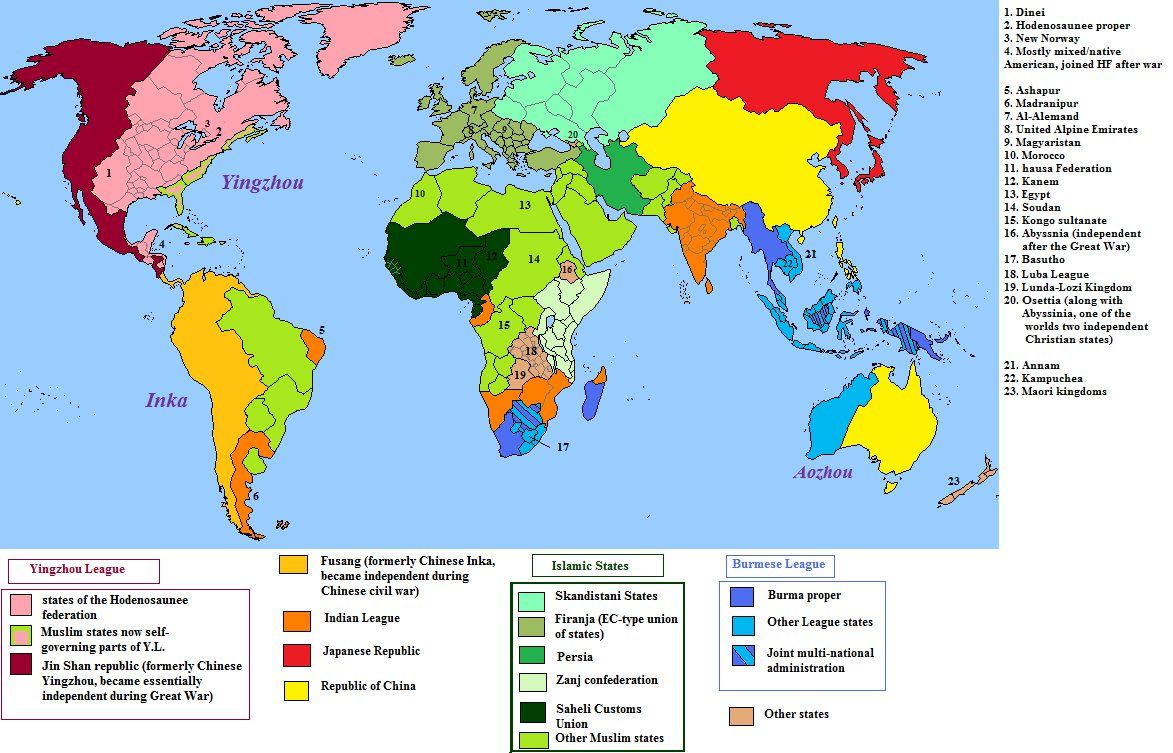
    Maps

    (click to see larger version)

    Map by Commdore

    The world in AH 1423 (2002 AD), at the end of Book IX

         I. Yingzhou
         II. Inka
         III. Firanja
         IV. Maghrib
         V. Sahel
         VI. Zanj
         VII. Ingoli
         VIII. Botswana
         IX. Skandistan
         X. Iran
         XI. Arabia
         XII. Greater Japan
         XIII. China
         XIV. Indian League
         XV. Burmese League
         XVI. Mindanao
         XVII. Aozhou
         XVIII. Maori


    Map by QuantumBranching

    The world in AH 1423 (2002 AD), at the end of Book IX


    Map by Hibernian

    A map of the world of the alternate history book “The Years of Rice and Salt”, by Kim Stanley Robinson. This map is based on one from the book (which is credited to Jeffrey L. Ward), it shows the four main blocs or alliances on the eve of the “Long War” (specific date is 1333 AH or 1915 AD). This is not an exact copy of the map in the book, which is very different; being a hand drawn map which uses an unusual map projection. The borders are correct to the book, however some areas are not shown properly on the book’s map and so I have had to interpolate a bit (i.e. the book’s map does not show the Caribbean islands at all, so I have just chosen to assign them to Dar al-Islam as this seems the most logical based on the history contained in the novel).


    26